
Catching the Moon
A translation project, its many difficulties and delights

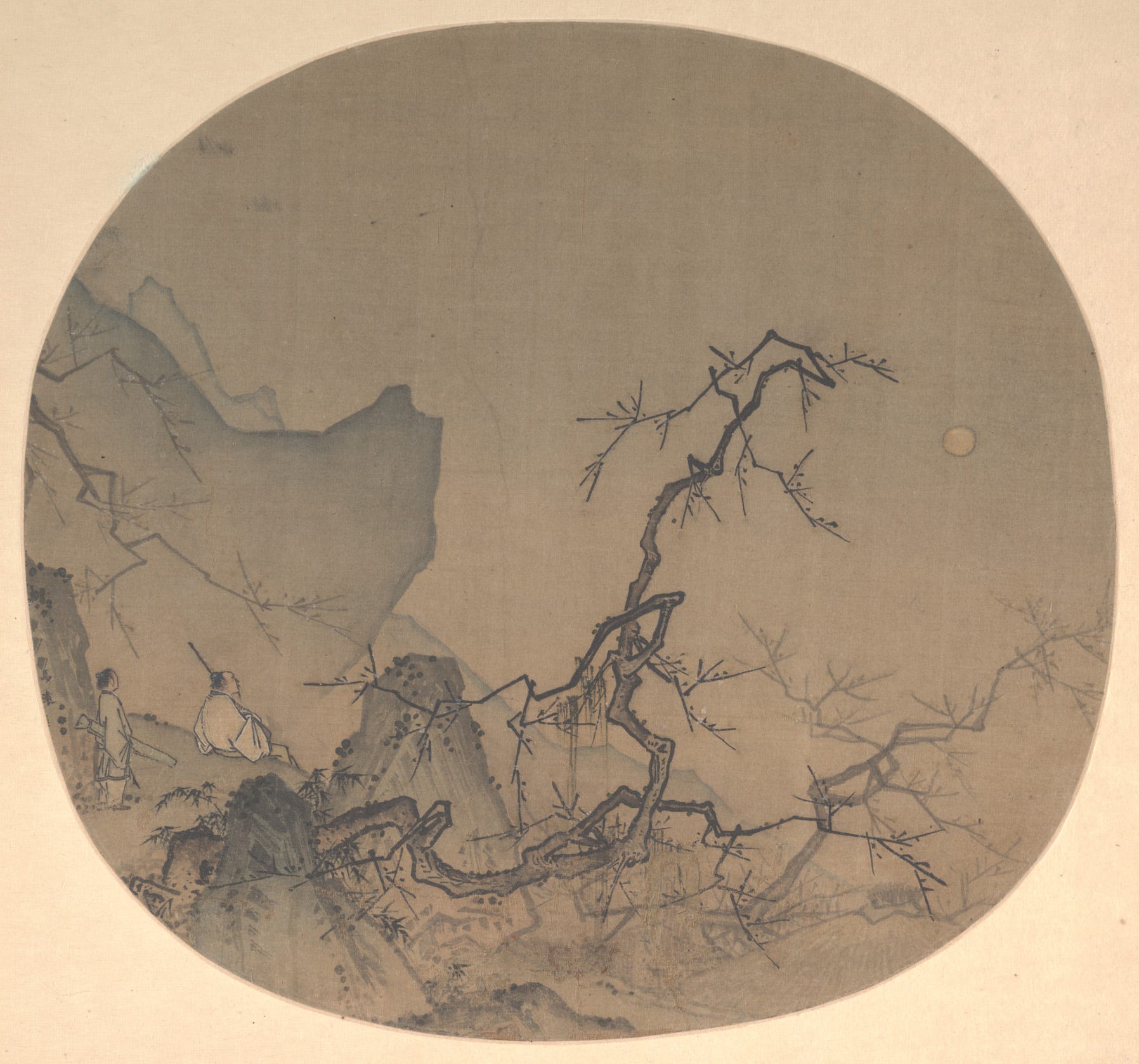
Popular legend had it that the Tang dynasty poet Li Bai died while drunkenly trying to embrace the moon. It isn’t exactly true, but it is a wonderful symbol for whatever it is the poet is trying to do when he writes; the world of the senses rises to meet him, and he does his best to return the favor. To anyone who surveys poetry with a dispassionate and distanced eye, writing it seems a nice pastime, even an exciting challenge. Melancholic poets of several centuries cry out: false! For the sake of a single poem, you must change your life.1 There is a translation process that occurs between the moment of inspiration and the act of writing something, anything, down on paper. Whatever first sparked my imagination—the Milwaukee River coursing past a graffitied bridge, my father as he stoops to water his tomatoes, a trick of the light—usually recedes faster than I can find words for it. That is all to say that writing poetry can be difficult, so it should go without saying that translating it from one language to another is harder… and yet, here I am, putting off one difficult project by picking up another.
This project was initially begun in earnest after I talked my father into joining me. Together, our qualifications are as follows: Dad: Native Chinese speaker, Chinese, from Taiwan, owns a book of Chinese poems. Me: My dad. Looking back, only one of us was in earnest. This led to weeks of texting my father poems and questions with only minimal responses back. Thankfully, we both enjoy unpredictable bursts of enthusiasm for novel projects; a recent visit home resulted in the both of us poring over his favorite poems for hours.
General Disclaimer
I will state this here and now for the first and last time: I am not a scholar of Chinese or Classical Chinese. My remarks here are the result of my own investigations born of curiosity, the fruit of rambling conversations with my father, and a testament to the many great resources and texts available (this book in particular). Are you a Chinese scholar? I wonder how you found this article but more than that, I wonder if you will be so generous as to comment with further thoughts, resources, or corrections!
The Moon
Anyone who gives Classical Chinese poetry even a cursory glance will notice a few repeating images: autumn (秋), washing clothes (擣衣), the numbers one thousand (especially one thousand miles 千里) and ten thousand (萬), and, of course, the moon (月).
The interplay between the exterior world, signified, usually, by a nature scene, and the interior world of the speaker is a feature of this type of poetry. This structure has a name: bi-xing, usually consisting of two lines of nature description followed by two lines of emotional expression. Still, some naturalistic elements are more common than others. Especially in the poems featured in the 300 Tang Poems, nature imagery could take up themes of separation, worry for loved ones, and the anxieties of wartime.
As my father explains it, the moon is a powerful image because it unites those who are far apart. Even 千里—1,000 miles away—two people, thinking of one another, can “be together” by gazing at the same moon.
The typical poem to cite in this case is well known by most native Chinese speakers, Li Bai’s “Quiet Night Thought” (靜夜思).
Here is Wikipedia’s translation, a bit archaic, but it does the job:
My casement veils glowing pools of moonbeams,
Perhaps on the ground is simply frost it seems;
Lifting my head I gaze up at the gleaming moon,
Bowing my head I ponder my homesick dreams.
And here is the pinyin:
Chuáng qián míngyuè guāng
Yí shì dìshang shuāng
Jǔtóu wàng míngyuè
Dītóu sī gùxiāng
The literal word-for-word translation:
Bed in front bright moon light
I think it is ground on top frost
Raise head look moon light
Lower head think home.
And here is my own translation, featured at the end of a poem published by Ekstasis:
Before my bed, I see moonlight—
It could be frost upon the ground.
I lift my head and see the moon,
I hang my head and think of home.2
Here is another of Li Bai’s poems, which features similar themes (separation during wartime, moonlight, as well as my favorite symbol: women washing clothes).
A slip of the moon hangs over the capital;
Ten thousand washing-mallets are pounding;
And the autumn wind is blowing my heart
For ever and ever toward the Jade Pass....
Oh, when will the Tartar troops be conquered,
And my husband come back from the long campaign!
This poem begins with a view of Chang’an, the ancient capital of China. Our first “glimpse” is of the capital city bathed in a sheet of moonlight. The sound of ten thousand women (or mallets) pounding laundry is heard. These women, going about their usual domestic duties, carry on even as war separates them from their husbands. The autumn wind blows continually, and the speaker is continually thinking of or longing for Jade Gate, one of the westernmost passes in the Great Wall. Beyond the Wall, it is implied, her husband fights invaders. She wonders: When will the day come to conquer the invaders? When will her husband finally return after the long campaign?
It is a beautiful poem. Like all of these it is potent, dense, and conjures up much more than what is said on the page. Here, again, the moon casts its light, holding together the two competing themes of separation and unity.
The moon isn’t always a figure for separation, though. In yet another Li Bai poem, it becomes a friend, a conspirator, the poet’s elusive beloved.
From a pot of wine among the flowers
I drank alone. There was no one with me –
Till, raising my cup, I asked the bright moon
To bring me my shadow and make us three.
Alas, the moon was unable to drink
And my shadow tagged me vacantly;
But still for a while I had these friends
To cheer me through the end of spring....
I sang. The moon encouraged me.
I danced. My shadow tumbled after.
As long as I knew, we were boon companions.
And then I was drunk, and we lost one another.
...Shall goodwill ever be secure?
I watch the long road of the River of Stars.
The Project
Hopefully the brief examples and analysis above gives a sense of the importance of the moon in Classical Chinese poetry. It is why I am titling this project “Catching the Moon.” The obvious aim is translation, however, a secondary objective is to provide some level of context for these poems. There is a whole wealth and world of meaning that these poems draw from. I want to be able to understand, to be moved, and, hopefully, to help those interested but intimidated to experience the same. While reciting a poem from Meng Jiao, tears began to spill from my father’s eyes. He didn’t bother to wipe them away. This is what I hope to provide for you, the ability to engage just a little more with these wonderful poems.
I’m very pleased with myself for this sentence.
The difficulties of translation are many. In this instance, it was nearly impossible for me to replicate the rhyme scheme (aaba) while preserving the sense of each line. I settled for blank tetrameter—tetrameter to convey, in some sense, the structural regularity of the lines (which follow a particular tonal pattern) as well as the inherent musicality of the words in the original (also impossible to preserve).
Isabella, I am in the middle of my own crazy translation project, so I deeply appreciate this. Maybe someday we can chat about it! I am going to audit the translation class next semester:) …. Also, I have an acquaintance who is from Hong Kong / Macao, who loves the poetry of St John of the Cross, and other mystical poets, and who might be able to speak to this project of yours. I can ask if he is open to sharing info if you like!
I LOVE Li Bai but have no knowledge of how to parse Chinese poetry so this was so wonderful to read. Filing away the explanation of the moon’s meanings for reference